
Cart
0
Strike Eagles Return Home Bearing Battle Scars and Horror-Themed Art
U.S. F-15E Strike Eagles returned from a Middle East deployment adorned with bomb markings and horror-themed nose art. Signaling their active combat role amid rising regional tensions.
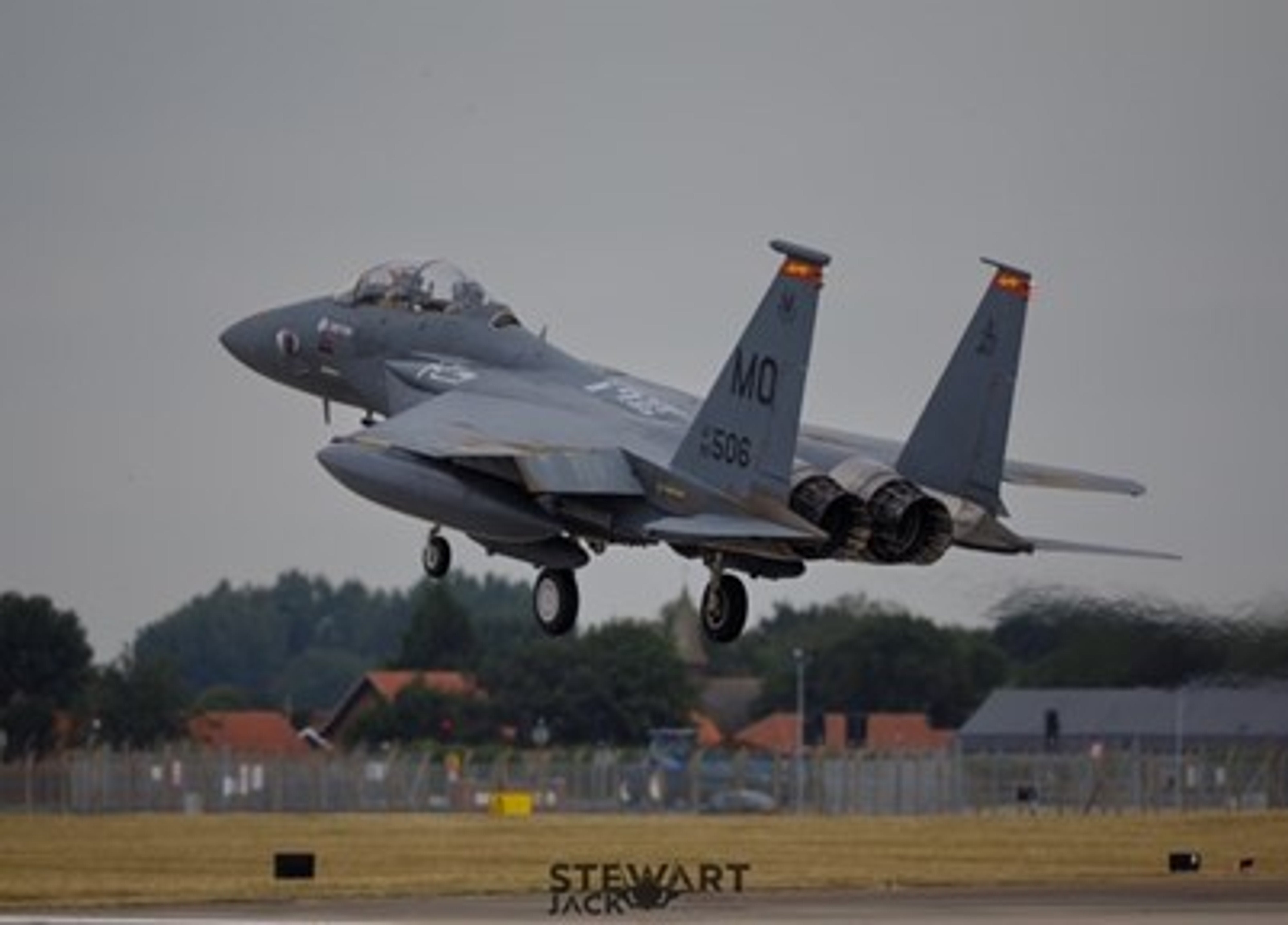
The F-15E “Candyman” about to land at RAF Mildenhall on Jul. 18, 2025. The aircraft also sports some text on the dorsal air brake via Getty Images
The F-15E Strike Eagles returning to their home base at Mountain Home Air Force Base, Idaho, feature unique bomb markings and horror-themed nose art following their deployment in the Middle East. Split into two cells with radio callsigns TABOR 81–86 and 91–92 and supported by KC-46A Pegasus tankers CLEAN 31 and 32, the first eight of twelve F-15E Strike Eagles from the 366th Fighter Wing arrived at RAF Mildenhall, UK, at 08:34 AM local time on July 18, 2025, en route back to Mountain Home AFB.
The aircraft were deployed to Jordan in October 2024 amid rising tensions between Israel and Iran. Their mission aimed to deter aggression and prevent a wider regional conflict following Israel’s targeted assassination of Hezbollah leader Hassan Nasrallah in Lebanon. U.S. officials had cited threats from Iran of an imminent ballistic missile attack on Israel shortly before reinforcing their regional presence. That threat materialized on October 1, 2024, and by October 7, the F-15Es transitioned through RAF Lakenheath on their way to deployment in the region.
Gear Spotlight- What Our Readers Are Picking Up


Few details have been disclosed regarding the missions flown by the 389th Fighter Squadron during this deployment. However, the bomb markings and nose art depicting horror movie characters on the aircraft suggest extensive operations. The markings indicate the use of JDAMs (Joint Direct Attack Munitions), AGM-158 JASSMs (Joint Air-to-Surface Standoff Missiles), and AGR-20 APKWS II (Advanced Precision Kill Weapon System II) laser-guided rockets. Some red lightning bolt symbols also appear, likely representing unidentified munitions.
While the use of AGR-20 APKWS II was anticipated, especially after CENTCOM released photos of an F-15E carrying six LAU-131A rocket launchers loaded with 42 AGR-20 rockets at Muwaffaq Salti Air Base in Jordan, the employment of AGM-158 JASSMs by F-15Es in the Middle East has not been officially confirmed. The AGM-158, available in both standard and extended-range variants, is a GPS-guided radar-evading cruise missile with a 2,250-pound warhead, designed for precision strikes on high-value, heavily defended targets.
In 2021, a Proof of Concept test by the 85th Test and Evaluation Squadron demonstrated that an F-15E could carry up to 15 JDAMs six per wing and three on the centerline allowing it to act as a “bomb truck.” Later that year, six F-15Es from the 494th Expeditionary Fighter Squadron at RAF Lakenheath deployed to Al Dhafra Air Base in the United Arab Emirates in this configuration, each loaded with twelve JDAMs and four Small Diameter Bombs (SDBs).
The JASSM markings on the recently returned F-15Es suggest their use in regional operations, possibly in support of Operation Midnight Hammer, which targeted Iran’s nuclear facilities last month. The Strike Eagles are also slated for integration with the AGM-158C-1 LRASM (Long Range Anti-Ship Missile), reportedly used in combat recently in the Middle East.
Regarding the APKWS integration on the F-15E, the weapon was initially designed as a cost-effective, laser-guided munition for ground targets and later adapted for air-to-air engagements against drones and cruise missiles. The U.S. Air Force first tested this capability in 2019, and F-16s operating around the Red Sea have since demonstrated its effectiveness. An APKWS rocket costs approximately $30,000, compared to $450,000 for an AIM-9X and over $1 million for an AIM-120 missile.
The F-15E’s ability to carry six LAU-131 pods, totaling 42 APKWS rockets alongside eight air-to-air missiles, gives it a potential 50 engagement opportunities. This configuration enhances flexibility, allowing the Weapons Systems Officer to laser-designate targets while the pilot engages threats, eliminating the need for paired operations.
The APKWS II, derived from the Hydra 70 unguided rocket, adds a laser-guidance kit between the warhead and motor, transforming it Into a precision weapon. The Distributed Aperture Semi-Active Laser Seeker (DASALS) system enables effective tracking of both stationary and moving targets. Under the FALCO program (Fixed Wing, Air Launched, Counter-Unmanned Aircraft Systems Ordnance), the AGR-20 version has been optimized for air-to-air engagements and demonstrated high success rates in counter-UAS missions.
BAE Systems has also introduced an infrared seeker for the APKWS II, making it a dual-mode weapon capable of targeting in both laser and infrared modes. This upgrade builds on the FALCO program and enhances the Air Force’s capacity to intercept various aerial threats.
Nose art on deployed Strike Eagles became standard practice following the 391st Expeditionary Fighter Squadron’s return from Operation Inherent Resolve in April 2019. Since then, it has symbolized unit pride and combat heritage for all F-15E squadrons operating in the CENTCOM region.


