
Cart
0
SpaceX Gains Ground as ULA's Vulcan Delays Shift National Security Missions
Delays with ULA's Vulcan rocket have shifted key national security launches to SpaceX, establishing it as the more reliable provider for U.S. defense missions.
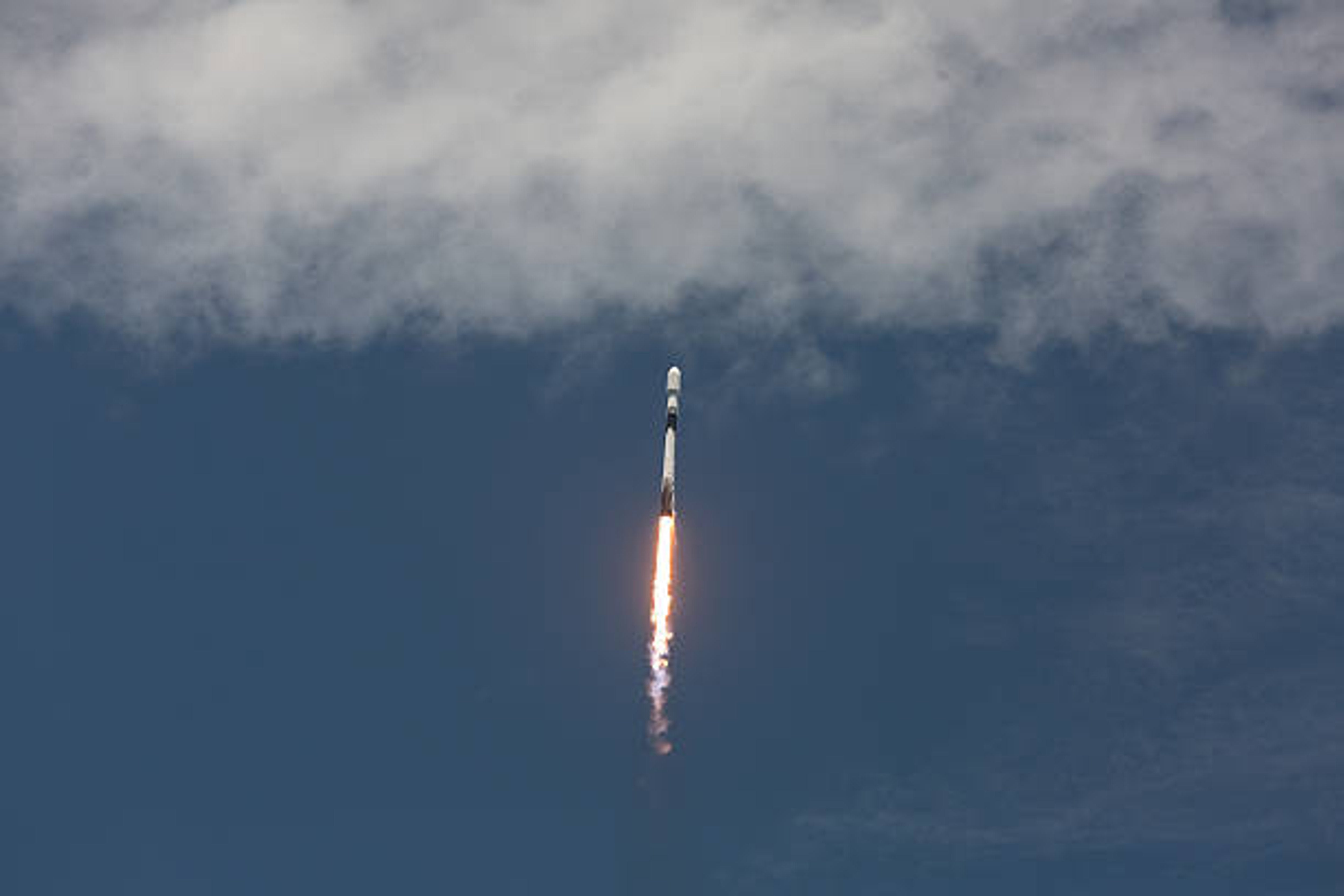
A SpaceX Falcon 9 rocket lifts off from launch pad 40 at the Cape Canaveral Space Force Station with the GPS III - SV 08 satellite built by Lockheed Martin. (Photo by Manuel Mazzanti/NurPhoto via Getty Images)
CAPE CANAVERAL, Fla. — United Launch Alliance’s continued delays with its new Vulcan rocket have led to a significant shift in national security launch assignments, with SpaceX stepping in as the more reliable provider. This trend continues Friday with a scheduled launch of the GPS III-7 mission on a Falcon 9 rocket from Cape Canaveral Space Force Station’s Space Launch Complex 40, with a window from 1:23 to 1:38 p.m. and a backup window Saturday from 1:18 to 1:34 p.m. The weather outlook is only 45% favorable for Friday, slightly improving to 50% Saturday, according to Space Launch Delta 45.
This mission marks the second originally awarded to ULA but reassigned to SpaceX under the National Security Space Launch (NSSL) Phase 2 contract. Initially slated to fly on ULA’s Vulcan, the December 2024 launch and this upcoming GPS III-7 mission were moved to SpaceX’s Falcon 9 due to prolonged certification delays for Vulcan, which is intended to replace the Atlas V and Delta IV rockets.
Gear Spotlight- What Our Readers Are Picking Up




Although labeled GPS III-7, the satellite is actually the eighth of ten constructed by Lockheed Martin to bolster the U.S. GPS system. It supports the Space Force’s push for faster deployment, cutting down the usual 24-month mission timeline to under three months from go-decision to launch.
“It highlights another instance of the Space Force’s ability to complete high priority launches on a rapid timescale,” said Space Force Col. Jim Horne, senior materiel leader of launch execution with the Assured Access to Space program.
The new GPS III satellites offer triple the accuracy and are eight times more resistant to jamming than the existing 38 in orbit. The urgency to deploy this enhanced hardware contributed to the decision to switch providers for the mission.
Under the NSSL Phase 2 contract, announced in 2020, ULA was originally allocated 60% of assignments with the expectation that all missions would fly on Vulcan by summer 2022. However, delays meant only 26 missions were eventually given to ULA, with 22 assigned to SpaceX. Two of those ULA missions have since been reassigned to SpaceX, though the Space Force has stated ULA will regain two future missions previously given to SpaceX.
To date, ULA has completed only one Phase 2 mission — and not with Vulcan, but with an Atlas V rocket flown last summer. Vulcan’s debut, initially targeted for mid-2020, faced setbacks due to the COVID pandemic, delays in acquiring engines from Blue Origin, customer payload issues, and a test stand fire, resulting in a nearly four-year delay.
Vulcan finally flew in January 2024, but its second flight in October encountered a booster detachment issue that delayed certification until March 2025. As of now, Vulcan is certified for only five of the nine required orbital mission types, with its first national security launch — USSF-106 — not expected before July 2025. The mission will carry the Navigation Technology Satellite-3, built by L3Harris, to geostationary orbit. That and USSF-51, launched last summer on an Atlas V, were part of a \$337 million task order issued in 2020.
ULA’s delayed performance has impacted its share of future contracts. Under the recently announced NSSL Phase 3 awards, covering \$13.7 billion over the next five years, SpaceX will receive 28 of 54 missions (52%), ULA will receive 19 (35%), and Blue Origin will receive seven (13%).
Major Gen. Stephen G. Purdy, acting assistant secretary of the Air Force for Space Acquisition and Integration, addressed the Vulcan delays in written testimony to the House Armed Services Committee’s Subcommittee on Strategic Forces. “In NSSL Phase 2, the ULA Vulcan program has performed unsatisfactorily this past year,” he wrote, citing delays to four national security launches and only partial certification for Vulcan.
Purdy emphasized that ULA and other underperforming contractors must “re-establish baselines, establish a culture of accountability, and repair trust deficit” to meet delivery expectations.
While ULA prepares only its second launch of 2025 — a commercial Amazon Project Kuiper mission using a remaining Atlas V, targeting no earlier than June 13 — SpaceX continues to dominate. Falcon 9 has already completed 64 launches this year, with 43 from the Space Coast alone.


