
Cart
0
India-Pakistan Clash Prompts Global Reassessment of Chinese Weapons After Reported J-10C Success
The India-Pakistan conflict has triggered a global reassessment of Chinese weapons, particularly the J-10C fighter jet, following its reported success against Indian aircraft.
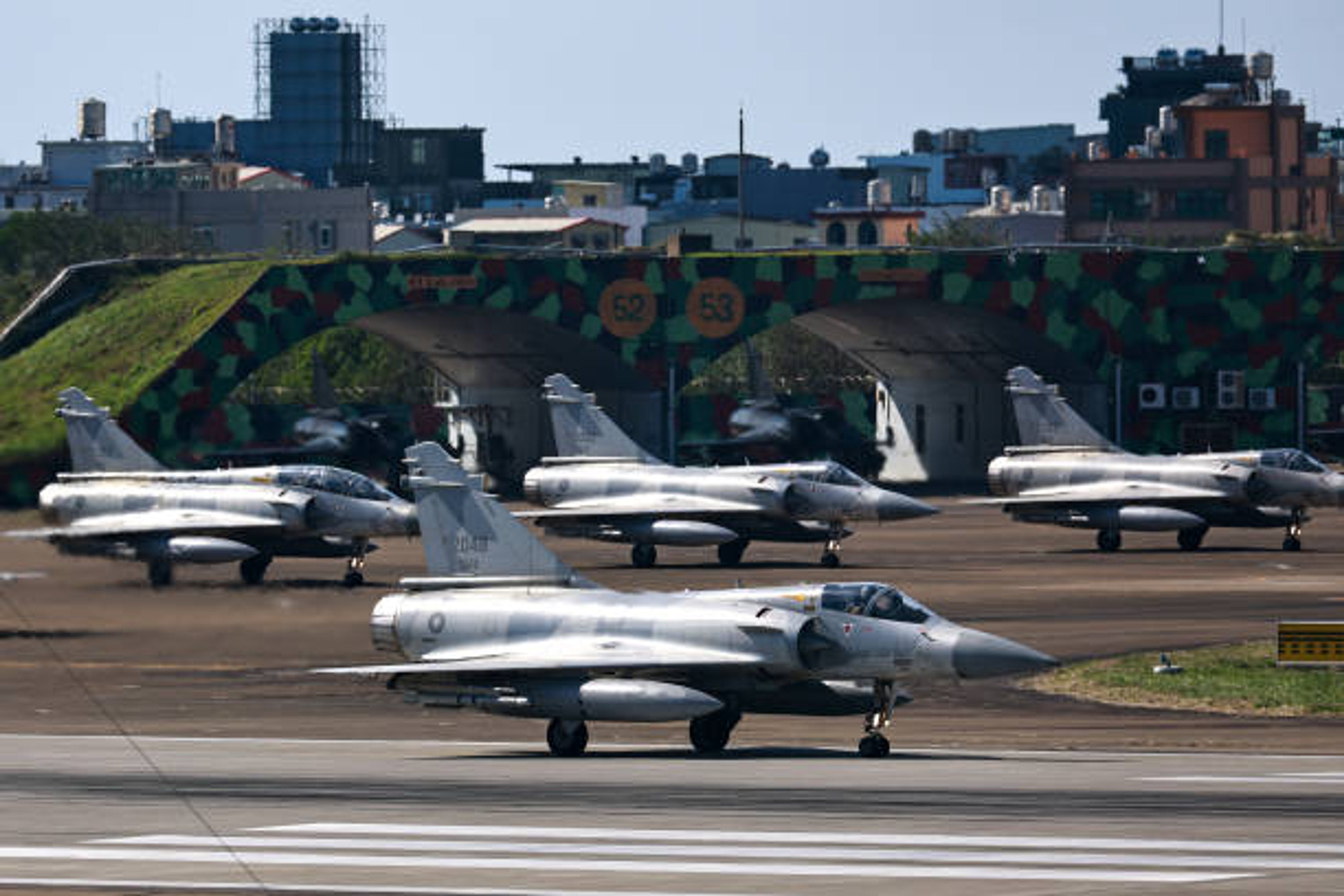
HSINCHU, TAIWAN - 7 NOVEMBER: A Taiwanese Air Force Mirage 2000-5 fighter jet prepares to take off, during the Sky Dragon aerial drill, at an airbase in Hsinchu, Taiwan, on 7 November, 2024. The 5-day exercise, which started on November 4, aims to test pilots' air-to-air, air-to-sea and air-to-ground combat skills with fighter jets such as F-16Vs, Mirage 2000-5s and Indigenous Defense Fighters (IDF), amid increasing Chinese People's Liberation Army military presence in and around the Taiwan. In late October, the United States approved 2 billion dollars in arms sales to the self-ruled island, which might include the National Advanced Surface-to-Air Missile Systems (NASAMS), while Taipei recently said the first batch of High Mobility Artillery Rocket Systems (HIMARS) has arrived from the United State. (Photo by Daniel Ceng/Anadolu via Getty Images)
The recent military confrontation between India and Pakistan is prompting a global reassessment of Chinese-made weapons, challenging longstanding views of their inferiority to Western arms and raising concern in regions wary of Beijing’s growing influence.
Pakistan claimed its Chinese-built J-10C fighter jets shot down five Indian aircraft, including French-made Rafales, during retaliatory strikes last week. While India has not commented and the claims remain unverified, the market capitalization of the J-10C’s manufacturer surged by more than 55 billion yuan (\$7.6 billion), a rise of over 25%, by week’s end.
Gear Spotlight- What Our Readers Are Picking Up



Hu Xijin, former editor-in-chief of China’s nationalist Global Times, warned that if the reports are true, Taiwan should be “even more scared.” China views the island as its territory and has not ruled out military action to bring it under control.
Taiwan is closely monitoring the developments, said Shu Hsiao-Huang, associate research fellow at Taipei’s government-funded Institute of National Defense and Security Research. “We may need to reassess the PLA’s air combat capabilities, which may be approaching — or even surpassing — the level of U.S. air power deployments in East Asia,” Shu stated, suggesting Washington may need to consider more advanced arms sales to Taiwan.
The J-10C’s reported performance marks its first known combat use and could alter perceptions of China’s People’s Liberation Army (PLA), which has been plagued by corruption scandals, especially within its Rocket Force — responsible for missiles and central to any potential conflict with Taiwan. The aircraft, which regularly patrols the Taiwan Strait, had previously faced doubts due to lack of combat experience.
Another Chinese weapon under scrutiny is the PL-15 air-to-air missile, reportedly used in the clash. Debris of the high-speed missile — capable of flying at over Mach 5 — was allegedly recovered in India, pointing to the PL-15’s successful operational deployment. The missile is seen as a rival to Western equivalents and adds to the significance of the incident.
China, the world’s fourth-largest arms exporter, primarily sells to developing countries such as Pakistan. However, the reported success of the J-10C could boost Beijing’s appeal to a broader array of potential buyers, especially as countries in the Global South consider diversifying their defense procurement amid calls from former U.S. President Donald Trump to increase military spending.
James Char, assistant professor at the China Program of the S. Rajaratnam School of International Studies, noted that the J-10C is not China’s most advanced fighter. “There is a good chance the weapons systems China is able to offer will be even more appealing to potential buyers,” Char said.
Defense spending has become a strategic issue for several developing countries balancing relationships with both the U.S. and China. While seeking to appease U.S. trade concerns, some nations may now also weigh Chinese arms purchases more seriously.
China’s arms exports have increased steadily, with a five-year average in 2020–2024 more than tripling from 2000–2004, based on data from the Stockholm International Peace Research Institute. However, specific export figures remain undisclosed by the Chinese government and its state-owned defense conglomerates.
Major Chinese defense firms include Norinco Group (armored vehicles and anti-missile systems), Aviation Industry Corporation of China (AVIC) — whose subsidiary Chengdu Aircraft Co. manufactures the J-10C — and China State Shipbuilding Corp., which produces frigates and submarines. These firms have been sanctioned by the U.S.
MIT Security Studies Program Director M. Taylor Fravel highlighted that the Rafale is a multirole aircraft, while the J-10C is optimized for aerial combat, potentially giving it an edge in dogfights. However, Chinese systems have long faced scrutiny for quality issues. Myanmar reportedly grounded its Chinese fighter fleet in 2022 due to structural faults, and Bangladesh issued complaints over hardware reliability last year. Pakistan’s Navy has similarly faced degraded performance in its Chinese-made F-22P frigates.
“China attracts customers for its military equipment with cut-rate pricing and financing but there are hidden costs — especially when gear malfunctions,” wrote Cindy Zheng in a Rand Corp. research paper prior to joining the U.S.-China Economic and Security Review Commission.
Eric Zhu, a senior associate analyst at Bloomberg Intelligence, noted that concerns about performance and interoperability with non-Chinese platforms have restricted Beijing’s arms exports beyond a core group of clients.
China’s Defense Ministry did not respond to requests for comment on past defects or the J-10C’s recent deployment. The Chinese government regularly states that its military seeks to promote global stability and that it prefers peaceful reunification with Taiwan.
President Xi Jinping’s push to modernize the PLA by 2027 has resulted in progress, including the December launch of next-generation amphibious assault ships — the largest of their kind — and reports of a test flight for a sixth-generation fighter jet, which fueled rallies in defense sector stocks.
Despite this, Fravel cautioned against labeling the J-10C’s possible battlefield success as a “DeepSeek moment,” referring to the AI chatbot that stunned the tech world earlier this year. “But it doesn’t need to be a DeepSeek moment to be significant,” he said. “A lot is being learned about how Chinese systems perform under combat conditions.


