
Cart
0
Information Clampdown Follows Series of Pedestrian-Car Incidents in China, Sparking Public Outcry
A series of pedestrian-car incidents in China, including crashes near schools, has sparked public outcry amid increased government censorship and limited information disclosure.
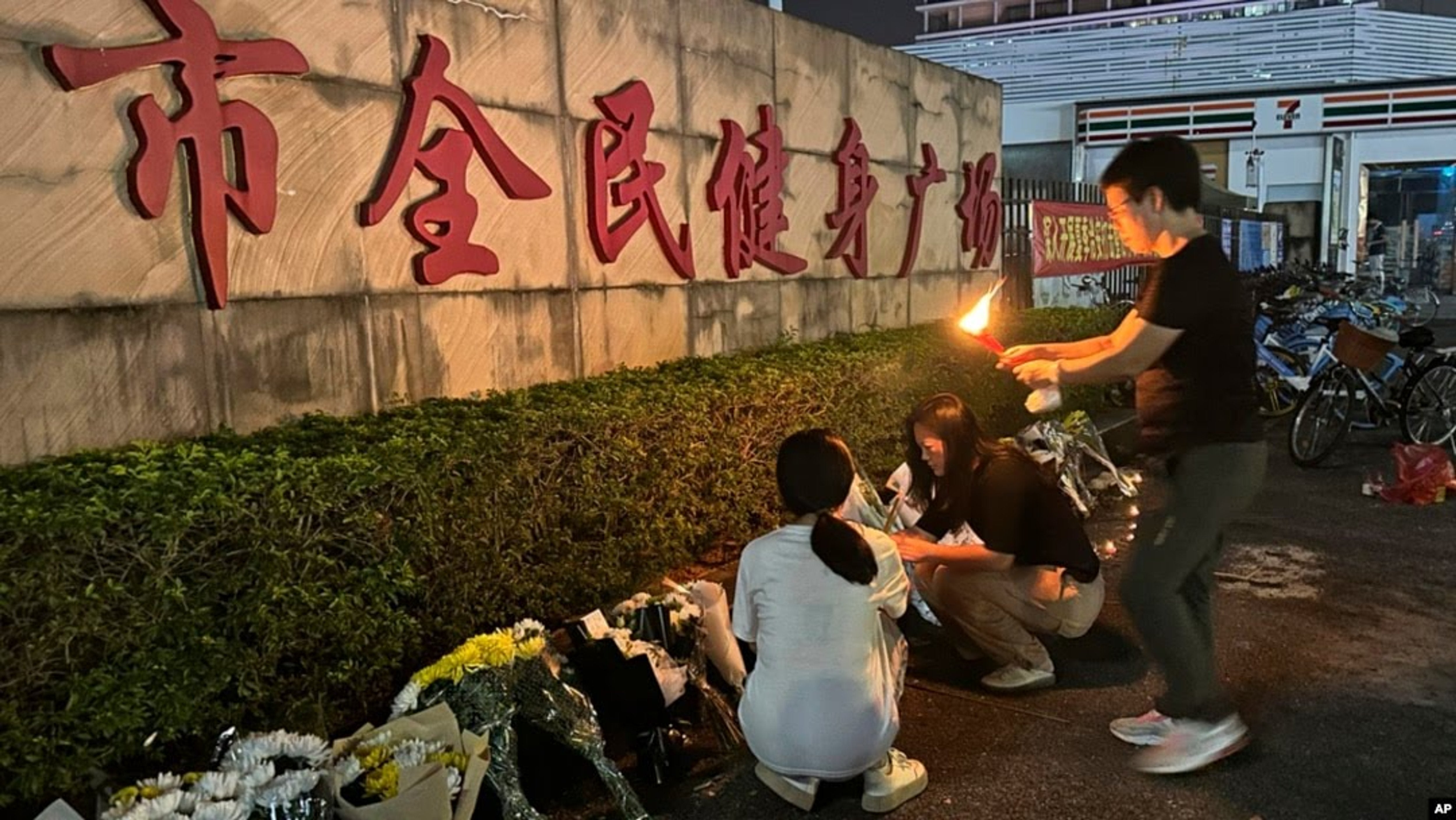
A woman lights a candle near flowers placed outside the Zhuhai People's Fitness Plaza where a man deliberately rammed his car into people exercising at the sports center, in Zhuhai in southern China's Guangdong province, Nov. 12, 2024.
A recent series of pedestrian-vehicle incidents in China, including crashes near elementary schools, has led to increased censorship and limited public information, fueling public frustration and online criticism.
Late last month, a car struck children near an elementary school in an outlying district of Beijing, according to a Chinese news report. A brief police statement confirmed that a 35-year-old male driver hit pedestrians due to “improper operation” of the car, but did not mention the school or that children were among the victims. Photos showing several people lying in the street were removed from the internet.
Gear Spotlight- What Our Readers Are Picking Up



“We need the truth,” one user posted on Weibo, a major Chinese social media platform.
Since President Xi Jinping came to power in 2012, the ruling Communist Party has intensified control over information, viewing it as a tool to prevent unrest. In recent months, mass attacks involving vehicles or knives appear to have become subject to increased censorship. Topics including the economy and LGBTQ+ issues have also faced growing restrictions.
Citizens have voiced complaints online about at least two recent vehicle incidents. Experts suggest the government may be seeking to prevent copycat crimes or cover up failures in local governance. However, the actual frequency of such attacks remains uncertain due to the limited flow of information.
Historically, authorities would release basic facts about such incidents, often attributing attacks to personal grievances such as financial loss. But that pattern appears to have shifted after a deadly case in November in Zhuhai, southern China, where 35 people were killed by a driver angry over a divorce settlement. The attack reportedly triggered top-level directives from Xi to prevent similar incidents.
Eight days later, an SUV struck students at an elementary school in Hunan province. The injury toll—30 children and adults—was only revealed nearly a month later when the driver was sentenced.
Since then, information has been more tightly controlled. In April, online reports said a vehicle had hit people outside a primary school in Jinhua city. Though three provincial media outlets briefly published stories, they were quickly removed, and no official information has been released.
Twelve days later, on May 4, a speeding car struck people at a bus stop in Tengzhou, eastern China. Authorities made no public statement. Videos of the crash were taken down, and social media posts calling for police transparency followed. Critics demanded basic details, including the driver’s identity and casualty figures, while some defended the silence, noting it was a holiday.
Hu Xijin, former editor of a state-owned newspaper, warned in a social media post that failure to release information could undermine norms of public disclosure. “If a few such precedents are set, and more local governments follow this way in the future, the rules of information disclosure may not be upheld and may be compromised,” he wrote.
Jennifer Pan, a Stanford University professor researching censorship and information manipulation, said local governments often seek to hide news that reflects poorly on them. The central government may later step in to protect system-wide legitimacy. In the Tengzhou case, the government released details 48 hours later, reporting six deaths and identifying the driver as drunk.
In recent weeks, Beijing authorities appear to be adopting a new approach: issuing quick but vague reports. On May 15, a car hit pedestrians near an elementary school in Beijing. The Beijing Traffic Police released a report within hours, stating that four people were injured on Jian’an West Road and that the driver was detained, but did not mention the school. That evening, police were seen patrolling the road, and a neighborhood watch volunteer reportedly warned residents not to talk to outsiders.
On June 26, online posts said a car had hit children in Miyun, about 60 kilometers (40 miles) from central Beijing. Caixin, a reputable media outlet, contacted local shop owners who confirmed children were hit and spoke with a hospital treating child victims. Whether the act was intentional remains unclear.


