
Cart
0
Former US Astronaut Calls for Scaling Back Cooperation with Russia on ISS, Citing Ukraine Invasion
Former US astronaut Terry Virts calls for scaling back cooperation with Russia on the International Space Station, citing Russia's invasion of Ukraine and comparing it to collaborating with Nazi Germany.
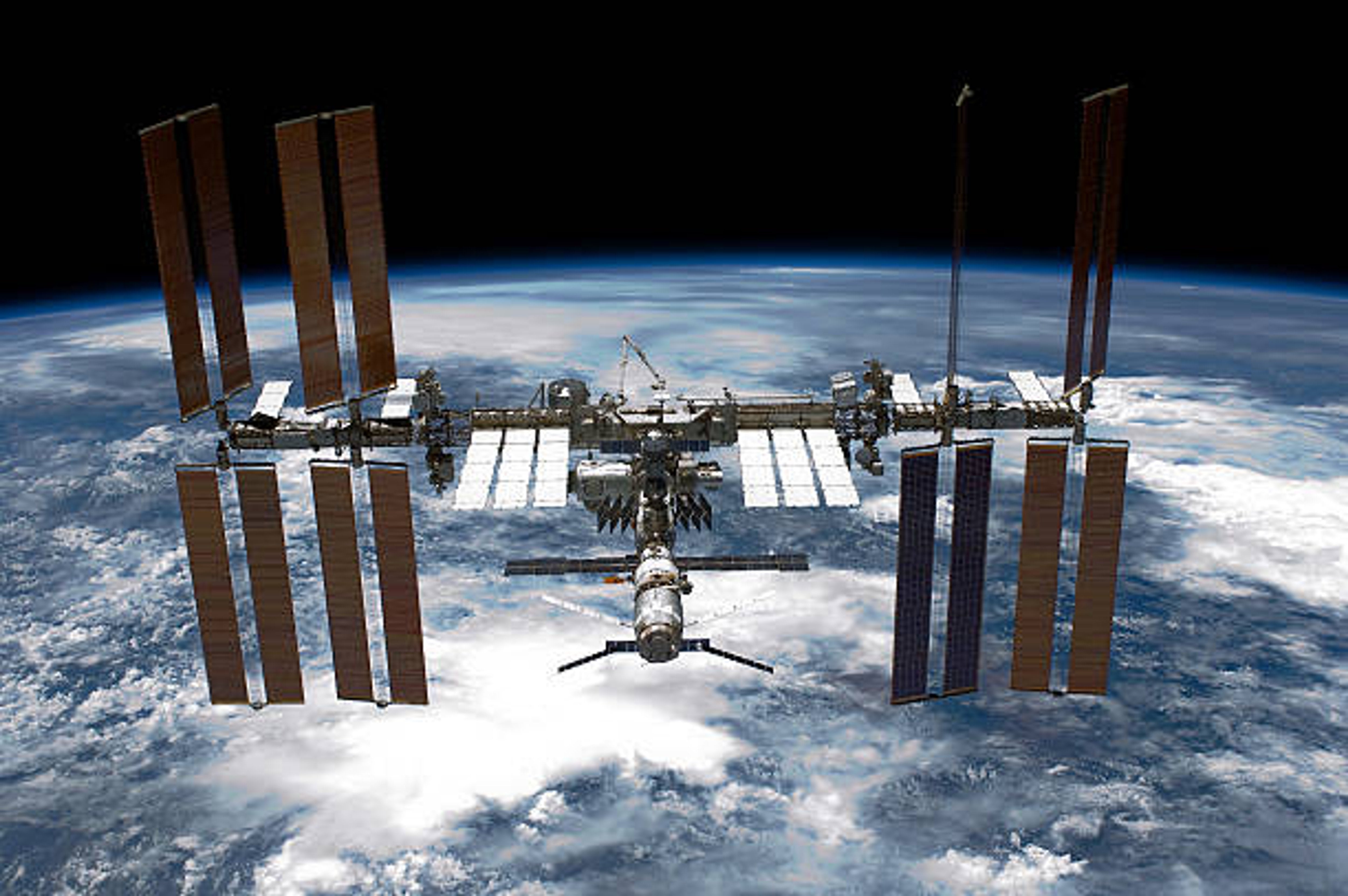
IN SPACE - MAY 29: In this handout provided by National Aeronautics and Space Administration (NASA), back dropped by planet Earth the International Space Station (ISS) is seen from NASA space shuttle Endeavour after the station and shuttle began their post-undocking relative separation May 29, 2011 in space. After 20 years, 25 missions and more than 115 million miles in space, NASA space shuttle Endeavour is on the last leg of its final flight to the International Space Station before being retired and donated to the California Science Center in Los Angeles. Capt. Mark E. Kelly, U.S. Rep. Gabrielle Giffords' (D-AZ) husband, has lead mission STS-134 as it delivered the Express Logistics Carrier-3 (ELC-3) and the Alpha Magnetic Spectrometer (AMS-2) to the International Space Station. (Photo by NASA via Getty Images)
A retired US astronaut has called for scaling back joint missions with Russia on the International Space Station (ISS), drawing a stark comparison to collaborating with Nazi Germany during World War II. Terry Virts, a former commander on the ISS, said cooperation with Russia has become "morally reprehensible" following Moscow's full-scale invasion of Ukraine in 2022.
The ISS remains one of the rare areas where cooperation between Russia and the West has continued, with astronauts from NASA, the European Space Agency (ESA), Canada, and Japan working alongside cosmonauts from Russia's Roscosmos. However, Virts argues that this cooperation should be curtailed, particularly when it comes to launching Americans on Russian Soyuz spacecraft and Russian cosmonauts on US rockets.
Gear Spotlight- What Our Readers Are Picking Up



"We need to stop launching Americans on the Russian Soyuz," Virts said. "We shouldn’t be launching Russian cosmonauts on our rocket while they’re actively destroying our friend and ally, Ukraine." While acknowledging the operational interdependence of the ISS, Virts believes cooperation with Russia can be scaled back in certain areas.
NASA responded by stating that it flies "integrated crews" with Roscosmos on both US crew spacecraft and Soyuz to ensure safe ISS operations. The agency emphasized the importance of continued cooperation for the space station's functioning.
Virts' stance is informed by his personal experience on the ISS. During his maiden voyage as a Space Shuttle pilot in 2010, he helped deliver the station's final permanent modules. Four years later, while on board the ISS, he witnessed rocket fire in eastern Ukraine as Russian-backed separatists launched an insurgency. Virts was shocked by the response of his cosmonaut colleagues, particularly Anton Shkaplerov, who proudly declared "Krym nash" ("Crimea is ours") after Russian troops seized the peninsula.
Virts also expressed disappointment with three other cosmonauts he flew with – Aleksander Samokutyaev, Maksim Surayev, and Yelena Surova – who later served as lawmakers in President Vladimir Putin's United Russia party. Samokutyaev remains in Russia's State Duma and has been sanctioned by the US, EU, and UK for supporting the invasion of Ukraine. Surayev and Surova have continued to agitate in support of Putin's policies.
The ISS is set to operate until 2030, and Russia has previously threatened to withdraw from the project but later agreed to remain involved until 2028. Virts' comments highlight the complexities and challenges of maintaining international cooperation in space exploration amid geopolitical tensions.
In a related development, controversy surrounds Alexey Zubritsky, a current ISS crew member who is wanted in Ukraine for treason after switching sides during the 2014 Crimean crisis. Virts believes the myth of space cooperation leading to better relations on Earth has been "dispelled" in light of Russia's actions in Ukraine.


